The research is real, and it is young. Mostly small studies and self-report rather than clinical trials, with samples in the dozens rather than the thousands. That is worth knowing before you read any of it, and worth saying before I quote any of it.
I am a licensed therapist as well as a labyrinth facilitator, which means I am held to a standard about what I claim. So: nothing below is a treatment claim, and I will not make one. What follows is what has actually been looked at, and what was actually found.
The walk I am best known for carries metta — loving-kindness — onto the path: the phrases arrive as you walk rather than being something you sit and recite. And loving-kindness meditation has been studied rather more than labyrinths have.
Hofmann, Grossman & Hinton, Clinical Psychology Review, 2011 gathered what was then known about loving-kindness and compassion meditation. Across the studies they reviewed, practice was associated with increases in positive emotion — among them joy, contentment, gratitude, hope and interest — and with warmer feeling toward strangers as well as toward oneself, after training as short as a few minutes. One study of people living with chronic low back pain found reductions in pain, anger and psychological distress compared with standard care, with more practice tracking lower pain and anger. Imaging work suggested the practice engages brain regions involved in emotional processing and empathy.
Their caution, not mine: the authors call the evidence base small and preliminary, note that techniques vary a great deal between studies, that samples were often small and the designs poorly controlled, and that a brief laboratory practice may not tell you much about a sustained one. They also observe that loving-kindness practice on its own showed modest effects, and may work best combined with mindfulness practice — which is, as it happens, the shape of what a metta walk on a labyrinth actually is.
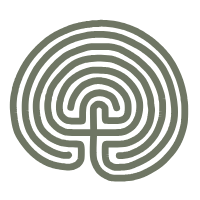
“Don’t confuse labyrinths with mazes. Mazes confound people with dead ends and the threat of getting lost. In contrast, labyrinths draw on classical designs that, however complex the route, guarantee an unobstructed progress to and from their centre.”
The clearest finding is not about labyrinths at all — it is about mazes. Solving a maze is work: the hippocampus builds a spatial map, holds it, and chooses turns against it. That is the navigating brain doing its job.
A labyrinth removes that job entirely. One path, no decisions, nothing to map. Whatever else is or is not established, that difference is real and it is the mechanism everything else is reaching for.
The Labyrinth Society maintains the bibliography — the only list that stays current, and the honest place to send anyone who wants the whole picture rather than my selection of it.